Showing posts with label security. Show all posts
Showing posts with label security. Show all posts
Sunday, September 3, 2017
Symantec speaks out on GAO medical device security report
Symantec speaks out on GAO medical device security report
Axel Wirth of Symantec has written an article about the recent GAO medical device security recommendations. While praises the execution of the study, he points out that the problems identified in the report represent just the tip of the iceberg. Heres a snippet from Symantec:
However, there is another set of risks to consider. As discussed above, the GAO report analyses the security risks of these compact, resource-restrained implantable devices. This is, of course, critical given the device�s impact on patient health and potentially, life or death. But the medical device infrastructure of healthcare systems and hospitals is far more complex. It includes a wide range of medical devices from simple to complex, from small to large, built on proprietary platforms or based on commercial, off-the-shelf software (COTS). The latter introduces its own set of risks through a �PC under the hood� design approach since the commercial operating systems or other software can easily become an entry point for malware, whether it targets the specific device or generally exploits a vulnerability specific to the chosen platform with the device then becoming �collateral damage�.In effect, Symantec is asking whether the scope of the GAO report was too narrow to capture a generalizable set of lessons about the ecosystem of medical device security risks. The implication? The medical device security iceberg is much bigger that the GAO report would indicate.
download file now

Monday, August 7, 2017
Study on St Jude medical device security deemed “inconclusive” by University of Michigan researchers
Study on St Jude medical device security deemed “inconclusive” by University of Michigan researchers
A recent report that alleged security flaws in St. Jude Medical�s pacemakers and other life-saving medical devices has major flaws of its own. That�s according to a team of University of Michigan researchers who say they�ve reproduced the experiments that led to the allegations, and come to strikingly different conclusions.
The U-M team is composed of several leading medical device security researchers and a cardiologist from the U-M Health Systems Frankel Cardiovascular Center. �Hyperbolic� and �sloppy� are words they use to describe the unorthodox report, which was released last week by short-selling investment research firm Muddy Waters Capital and medical device security firm MedSec, Ltd.
The U-M team reproduced the error messages the report cites as evidence of a successful �crash attack� into a home-monitored implantable cardiac defibrillator. But they showed that the messages are actually the same set of errors you�d get if you didn�t have the device properly plugged in.
Through these wires, implantable defibrillators can perform sensing operations and also send shocks if necessary.
�When these wires are disconnected, the device generates a series of error messages: two indicate high impedance, and a third indicates that the pacemaker is interfering with itself,� said Denis Foo Kune, former U-M postdoctoral researcher and co-founder of Virta Labs.
On page 17 of the Muddy Waters report, a screenshot cites these very error messages as proof of a security breach.
�But really the pacemaker is acting correctly,� Fu said. �To the armchair engineer it may look startling, but to a clinician it just means you didn�t plug it in. In layman�s terms, it�s like claiming that hackers took over your computer, but then later discovering that you simply forgot to plug in your keyboard.�
Added Foo Kune, �While there still could be security problems, the screenshot is anything but supportive of the claim. When researchers with limited medical training go public with unvetted claims, it�s easy to jump to conclusions.�
Ethicists and other researchers have criticized MedSec�s technique of teaming with a short-seller to publicize its preliminary findings�and benefit financially, no less.
Short-selling is an investment practice that essentially involves betting that a particular stock will decline in value. If it does, then the investment firm profits. In this case, MedSec made a deal with Muddy Waters to receive a share of those profits. St. Jude�s stock fell sharply over the weekend.
�It was the irresponsible thing to do. Think about whether you believe everything a used car dealer claims when deciding whether to buy,� said Wenyuan Xu, a visiting professor of electrical engineering and computer science at U-M and an expert in automotive and medical device security. She recently hacked into Tesla�s autopilot system to demonstrate its vulnerabilities.
To conduct the experiments, the U-M team used a new and properly functioning model of the same defibrillator that the Muddy Waters study used�the Fortify Assura VR. In several additional instances, they found that the device operated properly.
Even while the U-M research team finds fault with the Muddy Waters report, they don�t mean to suggest that these medical devices�or any medical devices for that matter�are necessarily secure. They stress the importance of establishing security workflows early on in the design process of medical devices.
�While medical device manufacturers must improve the security of their products, claiming the sky is falling is counterproductive,� Fu said. �Healthcare cybersecurity is about safety and risk management and patients who are prescribed a medical device are far safer with the device than without it.�
Thomas Crawford, an assistant professor of medicine and a clinical electrophysiologist at U-M, agrees. Crawford implants and follows patients with pacemakers and implantable defibrillators.
Thomas Crawford, an assistant professor of medicine and a clinical electrophysiologist at U-M, agrees. Crawford implants and follows patients with pacemakers and implantable defibrillators.
�Given the significant benefits from home monitoring, patients should continue to engage in it via St. Jude Medical Merlin, and other companies� respective proprietary home monitoring systems, before independent research can substantiate the claims made by MedSec and their financial partner Muddy Waters Capital, LLC,� Crawford said.
Crawford adds that home monitoring has been shown to reduce a variety of adverse events, with some studies even showing reduction in overall mortality over periodic checks of devices in the doctor�s office. The devices can send actionable alerts to a central monitoring service, which then is forwarded to the physician, so that it can be dealt with immediately if necessary. Alerts include low battery status, potential malfunction of the device, or changes in heart rhythm, which may require treatment.
The Archimedes Center for Medical Device Security offers a Medical Security 101 training in Orlando Jan. 15-17, 2017. Details will be forthcoming online. In the meantime, for more information, email archimedes@umich.edu.
Crawford adds that home monitoring has been shown to reduce a variety of adverse events, with some studies even showing reduction in overall mortality over periodic checks of devices in the doctor�s office. The devices can send actionable alerts to a central monitoring service, which then is forwarded to the physician, so that it can be dealt with immediately if necessary. Alerts include low battery status, potential malfunction of the device, or changes in heart rhythm, which may require treatment.
The Archimedes Center for Medical Device Security offers a Medical Security 101 training in Orlando Jan. 15-17, 2017. Details will be forthcoming online. In the meantime, for more information, email archimedes@umich.edu.
download file now
Monday, April 6, 2015
CM Security v2 3 2 APK
Baixar CM Security v2.3.2 APK -


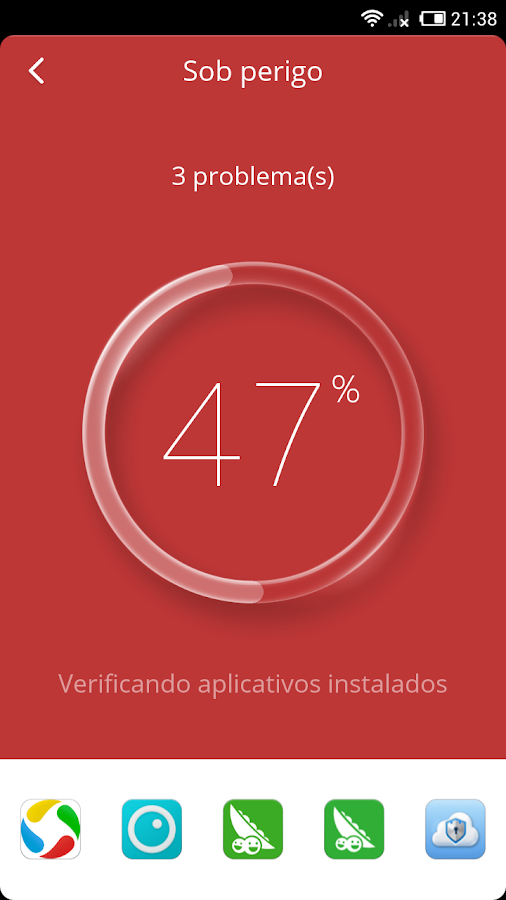
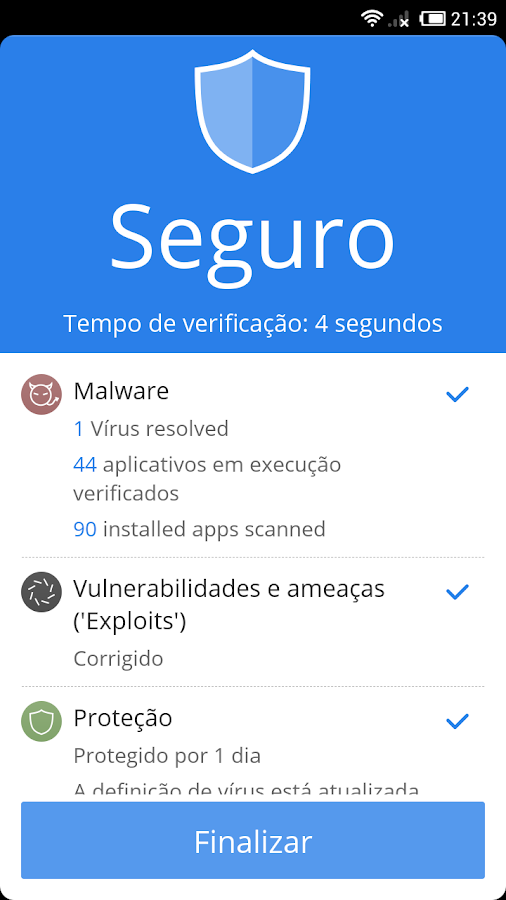 CM Security 2.3.2 APK
Google Play: Clique aqui
Versão: 2.3.2
Android: 2.3 ou superior
Tamanho: 7MB
Read more »
CM Security é considerado o número #1 pela AV-TESTE, mais uma vez! O prêmio é considerado o Oscar na área de segurança de TI e desenvolvimento de programas antivírus. A AV-TEST avalia programas antivírus com base em sua capacidade de detectar ameaças, na facilidade de uso, e premia os produtos considerados de alta qualidade.

Informações
Google Play: Clique aqui
Versão: 2.3.2
Android: 2.3 ou superior
Tamanho: 7MB
Instalação
Baixe o APK e instale!
Download
Zippyshare
CM Security Android Apk
com.cleanmaster.security
Subscribe to:
Posts (Atom)